
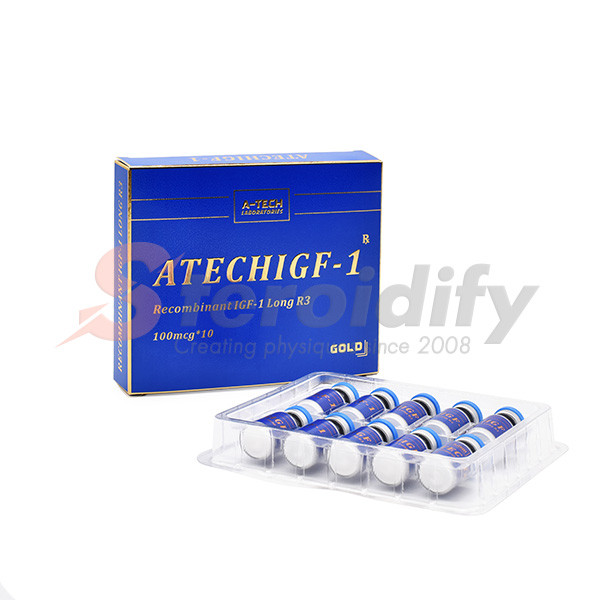
Buy Atech IGF-1 100mcg (KIT)
$338.00
Explore IGF-1 LR3 benefits for muscle development, fat metabolism, and recovery in laboratory research settings.
IGF-1 LR3 Receptor Grade
Buy Atech IGF-1 100mcg (KIT)
IGF-1 LR3 Receptor Grade is a synthetic analog of human insulin-like growth factor-1 (IGF-1). It is engineered with a 13–amino acid extension at the N-terminus, a modification designed to increase receptor affinity and reduce binding to IGF-binding proteins (IGFBPs), thereby extending its biological activity in experimental models.
In laboratory settings, IGF-1 LR3 interacts with the IGF-1 receptor (IGF1R), activating downstream signaling cascades such as the PI3K/Akt and MAPK/ERK pathways. These pathways are central to processes including cellular proliferation, differentiation, survival signaling, and metabolic regulation.
Potential Benefits of IGF-1 LR3 in Low Growth Hormone Research Contexts
In experimental and clinical research settings, IGF-1 LR3 has been studied for its potential role in addressing physiological effects associated with reduced growth hormone (GH) activity. As a modified analog of IGF-1 with extended activity, it is often examined for its influence on muscle tissue, metabolism, and cellular repair mechanisms.
Muscle Development and Strength Support of Atech IGF-1 100mcg (KIT)
IGF-1 LR3 is associated in research models with mechanisms involved in muscle adaptation, including:
- Cellular proliferation (hyperplasia) – increasing the number of muscle cells
- Mitogenic activity – supporting the formation of new muscle fibers
Additional observed mechanisms include:
- Enhanced protein synthesis
- Improved nitrogen retention
- Increased satellite cell activation
- Support for strength-related adaptations
These processes are particularly relevant in studies involving individuals with reduced anabolic signaling linked to low GH levels.
Metabolic and Fat Regulation Support
Research suggests IGF-1 signaling plays a role in metabolic regulation. In experimental contexts, IGF-1 LR3 has been associated with:
- Increased lipolysis (fat breakdown)
- Improved insulin sensitivity
- Enhanced nutrient partitioning
- Elevated metabolic activity
These effects may contribute to improved body composition in models of hormone insufficiency.
Recovery and Tissue Repair
One of the primary areas of interest in IGF-1 LR3 research is its involvement in tissue regeneration pathways. Studies indicate it may:
- Support cellular repair mechanisms
- Enhance recovery from physical stress
- Promote regenerative signaling activity
This is particularly significant in research involving delayed recovery often observed in low growth hormone states.
ATECHIGF-1 100 mcg (powder) KIT – A-TECH LABS

Reviews
There are no reviews yet.